
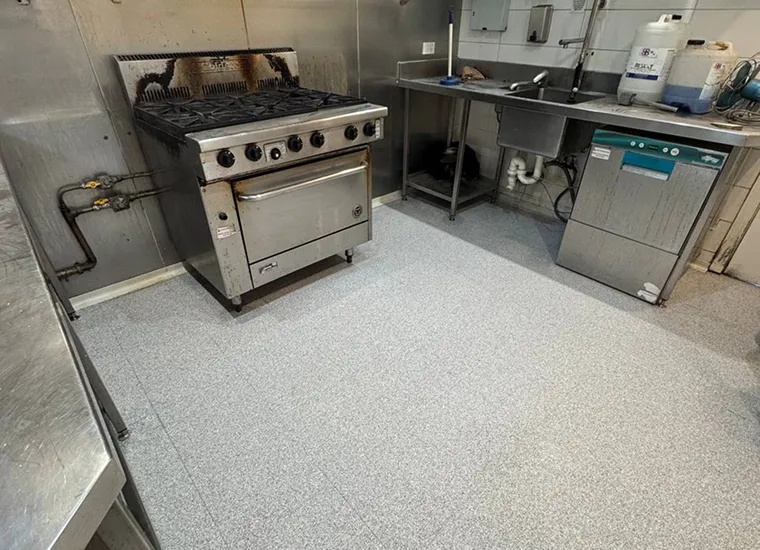
If you run a restaurant, café, or any food business in Melbourne, your kitchen floor is working harder than almost any other surface in the building — and it’s also one of the most heavily regulated. Get it wrong and you’re looking at failed health inspections, slip injuries, or a floor that needs replacing within a few years. Get it right, and you barely think about it again for a decade.
This guide covers everything you need to know about epoxy kitchen floor systems — what they are, why Melbourne’s commercial kitchens are moving away from tiles, what compliance actually requires, and what the process and cost look like in practice.
If you’ve already decided epoxy is the right fit and want the full service details, our commercial kitchen epoxy flooring page covers the specifics. This article is for anyone still weighing up the decision.
Why Commercial Kitchens Are Moving Away From Tiles
Tiles have been the default commercial kitchen flooring choice for decades, mostly because nobody questioned it. But tiles have a structural flaw that epoxy doesn’t: grout lines. Every joint between every tile is a place for grease, food particles, and moisture to collect — and no amount of scrubbing fully removes what’s worked its way into porous grout over months of service.
An epoxy kitchen floor solves this by creating a single seamless, non-porous surface. There are no joints, no grout, and nowhere for bacteria to hide. That’s the core reason Melbourne restaurants, cafés, and hotel kitchens have shifted toward epoxy over the past decade — not because it’s trendy, but because it directly addresses the hygiene problem tiles can never fully solve.
It’s not really “epoxy vs tiles” on durability alone — tiles can be tough too. It’s seamless vs jointed. A seamless floor is inherently easier to keep compliant, because there’s no hidden surface area for contamination to build up in.
Compliance — What a Commercial Kitchen Floor Actually Needs
This is the part most flooring guides skim over, but it’s the part that actually matters if you’re running a food business in Victoria. Your floor isn’t just a surface — it’s something your local council’s environmental health officer will assess.
| ✓ | FSANZ Food Safety Standard 3.2.3 – floors must be smooth, non-absorbent, easy to clean, and free of pooling water. |
| ✓ | AS 4586 slip resistance – commercial kitchen floors need an R10–R12 slip rating in cooking and food prep zones, R12+ in wet areas like dishwashing. |
| ✓ | Integral coved skirting – under AS 4674-2004, the join between floor and wall must be sealed, not left as a 90-degree gap where grime collects. |
A properly installed epoxy kitchen floor satisfies all three of these by design — the seamless surface meets the FSANZ Standard 3.2.3 non-absorbent surface requirement, an anti-slip aggregate topcoat delivers the correct AS 4586 slip resistance rating, and coved skirting is built into the installation rather than added as an afterthought.
Who Needs Commercial Kitchen Epoxy Flooring In Melbourne
We install commercial kitchen epoxy flooring across a wide range of Melbourne food businesses — anywhere food is prepared at commercial scale and council inspections apply.
🍽️
Restaurants
☕
Cafés
🏨
Hotel Kitchens
🥖
Bakeries
🏭
Food Processing
🏫
School Canteens
How a Kitchen Epoxy Floor Is Installed
The process matters more than people expect — a rushed installation is the most common reason epoxy floors fail early in commercial kitchens, where moisture and chemical exposure are constant.
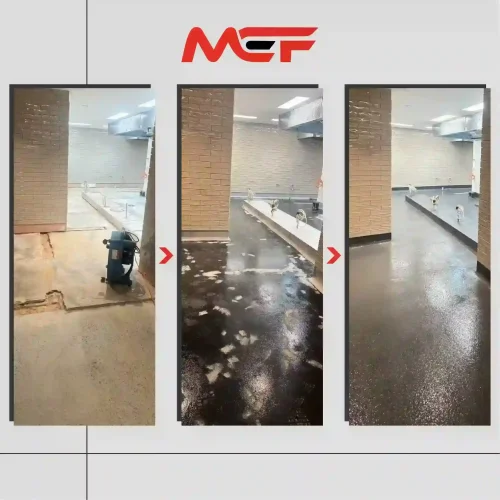
| 01 | Site Assessment We inspect the existing floor, test concrete moisture levels, and check for contamination from years of grease and cleaning chemicals before specifying the system. |
| 02 | Diamond Grinding The concrete substrate is mechanically profiled to create the surface texture epoxy needs to bond permanently — no shortcuts here. |
| 03 | Crack Repair & Levelling Any cracks, expansion joints, or low spots are filled and levelled before coating begins. |
| 04 | Epoxy System Application Typically a primer, body coat, and high-build topcoat — with anti-slip aggregate broadcast into the final layer to meet your required slip rating. |
| 05 | Coved Skirting & Handover Wall-to-floor junctions are coved and sealed for FSANZ compliance. Most kitchens are back in full service within 48–72 hours. |
What Does an Epoxy Kitchen Floor Cost?
Pricing depends on floor area, the condition of the existing concrete, the system specification, and whether coved skirting and extensive prep work are required. As covered in more depth in our guide on industrial epoxy floor costs in Melbourne, the biggest cost variable isn’t usually the epoxy itself — it’s how much surface preparation the existing floor needs.
Commercial kitchen installations sit at the higher end of the epoxy pricing spectrum compared to a standard warehouse floor, because food-safe certified materials, higher slip-resistance topcoats, and mandatory coved skirting all add to the scope. The most accurate way to know your number is a free on-site assessment, where we inspect your specific kitchen and provide a fixed-price proposal.
FAQs - on Epoxy Flooring in Melbourne
Is epoxy flooring better than tiles for a commercial kitchen?
For hygiene compliance specifically, yes — epoxy’s seamless surface has no grout lines for grease and bacteria to collect in, which tiles inherently have. Tiles can still be durable, but epoxy is generally easier to keep compliant with FSANZ standards over the long term, and is faster to install than retiling in most cases.
How long does an epoxy kitchen floor take to install?
Most commercial kitchen installations take 1 to 3 days depending on floor area and the condition of the existing surface. The floor is typically walkable within 24 hours, with full kitchen operations — including steam cleaning — possible within 48 to 72 hours.
Will an epoxy kitchen floor pass a council health inspection?
A properly specified and installed system will meet FSANZ Food Safety Standard 3.2.3, AS 4586 slip resistance requirements, and AS 4674-2004 coving requirements — the three standards your local environmental health officer will be checking for. We can provide documentation of the installed system’s specifications for your council sign-off.
Can epoxy be installed over my existing kitchen tiles?
In some cases, but we generally recommend removing existing tiles first. Tiles must be fully bonded with no hollow sections for epoxy to be applied directly over them, and removing them gives a stronger, longer-lasting bond. We assess this during the site visit.
How do I maintain an epoxy kitchen floor once it's installed?
Daily hot water mopping combined with a food-safe, non-abrasive sanitiser is generally enough. Avoid bleach as a daily cleaner, abrasive pads, and standing water left to dry. Our full epoxy floor maintenance guide covers cleaning routines specific to commercial kitchens in more detail.
Planning a Kitchen Floor Upgrade?
Free on-site assessment across Melbourne & Victoria · Fixed-price quote within 24 hours