
Commercial Kitchen Epoxy Flooring Melbourne
Get A Free Quote!
Response within 24 hours
- contact@melbourneepoxyflooring.com.au
- Melbourne, VIC, Australia
Why Melbourne Commercial Kitchens Choose Epoxy Flooring
Every Melbourne commercial kitchen faces the same daily punishment — hot grease
spills, harsh caustic cleaning chemicals, constant foot traffic, and the pressure
of passing council environmental health inspections. Standard floor tiles crack at
grout lines, harbour bacteria, and become dangerously slippery when wet.
Commercial kitchen epoxy flooring eliminates all of it.
We install food-safe epoxy floor systems for restaurants, cafés, hotels, aged care
facilities, and food processing plants across Melbourne and regional Victoria. Our
seamless, non-porous epoxy systems comply with FSANZ Standard 3.2.3 and Australian
Standard AS 4586 for slip resistance — so your kitchen passes inspections first time
and your floors perform for 10 to 20 years under daily commercial use.
From neighbourhood café fit-outs in Brunswick and Fitzroy to large hotel kitchen
refurbishments in the CBD and food manufacturing facilities in Dandenong,
Laverton, and Campbellfield — every project follows the same non-negotiable
standard: correct concrete preparation, a compliant anti-slip system, integral
coved skirting, and a floor that passes the council inspector’s first visit.
Why Choose Kitchen Epoxy Flooring?
- Extreme durability for heavy traffic
- Easy to clean and maintain
- Dust-free surface
- 10+ year lifespan
- Chemical and stain resistant
- Reflects light, reducing energy costs
- Slip-resistant options available
- Australian standards compliant
How Much Does Commercial Kitchen Epoxy Flooring Cost in Melbourne?
Commercial kitchen epoxy is a specialist application — it requires food-safe
certified materials, high-grade anti-slip topcoats, and integral coved skirting,
which sets it a tier above standard warehouse or garage epoxy. The investment
reflects that.
Key factors that influence the cost of your project:
- Floor area — larger jobs cost less per m² due to fixed mobilisation costs.
- Concrete condition — slabs requiring extensive diamond grinding, crack repair, or
moisture mitigation testing take more time to prepare correctly. - System specification — the number of coats, epoxy grade, and required slip-resistance
rating for your specific environment. - Coved skirting — integral coving adds to the scope but is frequently mandatory to
achieve FSANZ compliance on commercial food premises. - Access and trading hours — installations outside normal business hours or across
weekends may attract a time premium.
What most Melbourne hospitality operators find is that commercial kitchen epoxy
compares very favourably to retiling — which carries higher material and labour
costs and still leaves grout lines that fail hygiene audits. Epoxy delivers better
compliance at a lower total cost of ownership over the floor’s lifetime.
Every kitchen is different. The most accurate way to understand your project cost
is a free on-site assessment — we inspect the concrete, measure the area, and
provide a fixed-price written proposal within 24 hours, at no obligation.
Get A Free Quote!
Response within 24 hours
- contact@melbourneepoxyfloor.com.au
- Melbourne, VIC, Australia
Our Melbourne Kitchen Epoxy Installation Process
We follow a structured four-stage installation process on every commercial kitchen
project, regardless of size.
- Stage 1 — Concrete Assessment & Preparation
The floor is tested for moisture vapour transmission, existing contaminants, and surface hardness. We diamond grind or shot blast the concrete to open the surface profile — the single most important factor in epoxy adhesion and long-term performance. - Stage 2 — Crack & Joint Repair
Any cracking, spalling, or uneven areas are repaired and feathered before any coating is applied. Skipping this step leads to premature delamination — we never skip it. - Stage 3 — Epoxy System Application
A food-safe primer coat is applied, followed by the body coat and a certified anti-slip topcoat. Integral coved skirting is formed at the wall-floor junction during this stage to create a seamless, hygienic seal. - Stage 4 — Inspection & Sign-Off
We inspect the finished floor for coverage, slip resistance, and cove integrity before handing over. We can provide documentation confirming compliance with FSANZ 3.2.3 and AS 4586 if required for your council records.
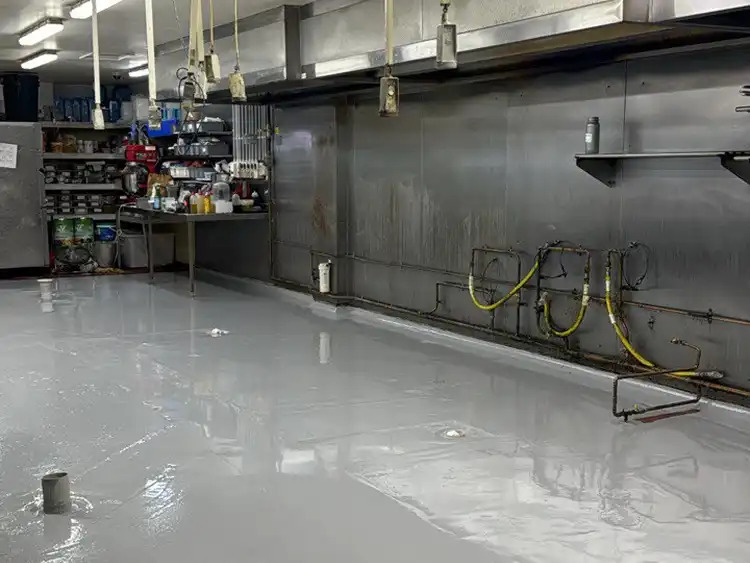
Melbourne Kitchen Epoxy Project — What to Expect
Over the years, we’ve installed commercial kitchen epoxy flooring across hundreds of Melbourne venues — from small neighbourhood cafés in Brunswick and Fitzroy to large hotel kitchens in the CBD and food processing facilities in Dandenong and Laverton. Every job follows the same standard: full concrete preparation, a compliant anti-slip system, integral coved skirting, and a floor that passes the council’s environmental health inspection the first time.
Our gallery shows completed kitchen, café, and food-facility epoxy flooring projects across Melbourne’s suburbs.
Areas We Service Across Melbourne
We install commercial kitchen epoxy flooring across metropolitan Melbourne and
surrounding regions, including:
CBD, Southbank, Fitzroy, Collingwood, Richmond, South Yarra, St Kilda, Brunswick, Coburg
Preston, Reservoir, Thomastown, Campbellfield, Epping, Broadmeadows
Box Hill, Ringwood, Croydon, Lilydale, Bayswater
Moorabbin, Cheltenham, Frankston, Dandenong, Cranbourne
Footscray, Sunshine, Laverton, Werribee, Hoppers Crossing
FAQs - on Epoxy Flooring in Melbourne
Is a kitchen epoxy floor slippery, especially when wet or oily?
A high-gloss epoxy finish is slippery when wet. For commercial kitchens, we always specify an anti-slip aggregate in the topcoat to achieve a minimum R11 slip-resistance rating under AS 4586 — the rating required for wet food preparation areas.
Does kitchen epoxy meet Australian food safety and hygiene standards?
Yes. A correctly installed seamless epoxy system is non-porous and compliant with FSANZ Standard 3.2.3 for food premises hygiene. Integral coved skirting — which we include on all kitchen projects — satisfies the wall-floor junction requirements inspectors look for.
How long does kitchen epoxy flooring last in a commercial environment?
10 to 20 years with proper installation and routine cleaning. The lifespan is largely determined by concrete preparation quality on day one — correctly prepared concrete produces a bond that outlasts the building fit-out.
Can you install over a weekend to avoid kitchen downtime?
In most cases, yes. We schedule after-hours and weekend installations regularly for operating restaurants and cafés. Epoxy requires 24–48 hours cure time before foot traffic, so a Friday night start typically allows a Monday morning reopening.
Can epoxy be installed over existing kitchen tiles?
Tiles must be fully bonded, flat, and correctly prepared before epoxy can be applied over them. Where tiles are loose, hollow, or grout lines are deep, removal is recommended to ensure adhesion directly to concrete — which produces a superior, longer-lasting result.
What R-rating slip resistance is required for commercial kitchens in Victoria?
FSANZ and WorkSafe Victoria guidance recommends a minimum R11 rating for wet commercial kitchen floors under AS 4586. High-risk zones such as dishwashing areas or coolroom entries may require R12 or higher. We specify the appropriate rating during the site assessment.
How do I clean and maintain an epoxy kitchen floor?
Epoxy is one of the easiest commercial floors to maintain. Daily cleaning with a pH-neutral degreaser and warm water is sufficient for most kitchens. Avoid abrasive pads on the topcoat. We provide a full maintenance guide on handover.
What is integral coved skirting and is it required?
Integral coved skirting is the curved epoxy transition where the floor meets the wall, eliminating the right-angle join that harbours bacteria and moisture. It is a requirement for FSANZ compliance on food premises and is included as standard on all our kitchen epoxy installations.
Ready to Upgrade Your Commercial Kitchen Floor?
Get a free, no-obligation quote for your commercial kitchen epoxy flooring project. Our team will assess your space and provide a detailed proposal within 24 hours.
Get A Free Quote!
Nospam, We Typically respond within 24 hours