
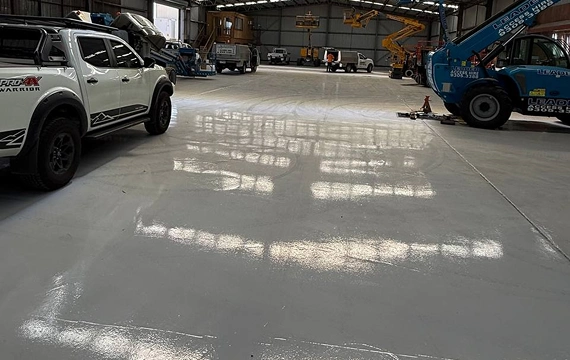
One of the first questions almost every client asks us — usually a week or two after installation — is some version of “so… how do I actually look after this thing?” It’s a fair question. A freshly installed epoxy floor looks flawless, and nobody wants to be the one who ruins it with the wrong mop bucket.
Here’s the good news: epoxy floor maintenance is genuinely simple compared to almost any other commercial flooring option. But “simple” doesn’t mean “no rules” — and the handful of things you shouldn’t do matter more than the things you should.
This guide covers how to clean epoxy floors properly, what to avoid, how often to do it, and how long a well-maintained epoxy floor should actually last in a Melbourne commercial or industrial setting — whether that’s a commercial kitchen, a workshop, or a warehouse.
Why Epoxy Floor Maintenance Matters More Than People Think
Epoxy is often sold on the promise of being “low maintenance” — and it is, relative to tiles, vinyl, or bare concrete. But low maintenance isn’t the same as zero maintenance, and the gap between the two is where most floor problems start.
A seamless epoxy surface doesn’t develop cracks or grout lines the way tiles do, so visually it can look fine for years even while small issues build up underneath the surface — grit grinding into the topcoat, chemical residue slowly dulling the finish, or moisture sitting in a corner that never quite dries.
The floors that last the full 10–15 years aren’t necessarily the ones installed with the most expensive system. They’re the ones that get a basic cleaning routine from day one.
The floors that fail early are almost always the ones where “low maintenance” got interpreted as “no maintenance” — and by the time someone notices the topcoat has worn through in a high-traffic lane, the damage has already reached the base coat.
Daily & Weekly Cleaning — The Basics
For most commercial and industrial epoxy floors in Melbourne, the day-to-day routine is straightforward:
| ■ | Sweep or dust-mop daily – Grit and dust are the real enemy of an epoxy topcoat. Loose particles get ground into the surface under foot traffic, forklift wheels, or trolley castors, slowly creating a dulling, sandpaper-like wear pattern. |
| ■ | Damp mop weekly – Warm water is genuinely enough most of the time. For a deeper clean, a small amount of pH-neutral cleaner diluted in warm water works well. Apply, let it sit briefly, then mop or squeegee it off. |
| ■ | Use a neoprene squeegee for larger areas – In warehouses or workshops, a wet-vac or ride-on scrubber with a neoprene squeegee attachment clears water and grime far faster than mopping, without leaving streaks behind. |
| ■ | Spot-clean spills immediately – Epoxy resists staining far better than bare concrete, but oils, fuels, and food acids left overnight can still dull the finish over time, particularly on lower-grade topcoats. |
What NOT to Use on an Epoxy Floor
This is the section that actually prevents premature wear, and it’s the one most cleaning guides skip past too quickly.
| × | Abrasive pads, steel wool, or scouring brushes – these physically scratch the topcoat, creating micro-scratches that dull the gloss and give dirt somewhere new to sit. |
| × | Harsh acidic or alkaline cleaners – bleach, concentrated ammonia, and strong degreasers can break down the epoxy resin’s surface chemistry over repeated use, leading to a chalky or hazy finish. |
| × | Vinegar-based cleaners – a popular “natural” choice for homes, but the acidity can etch and dull an epoxy surface over time. Avoid it on commercial epoxy floors entirely. |
| × | Standing water left to dry – particularly relevant for kitchens. Pooled water that evaporates slowly can leave mineral deposits and contribute to moisture issues underneath the coating. |
| × | Dragging equipment with damaged wheels – the single most common cause of visible scratching in warehouse floors. Worn castor wheels with exposed metal will cut into even a high-build epoxy system over time. |
If your cleaning team uses a single all-purpose cleaner across the whole facility, it’s worth checking the label against this list — many commercial-grade degreasers and disinfectants are more aggressive than they need to be for an epoxy surface.
Maintenance by Environment — Kitchens, Workshops & Warehouses
Each environment we install epoxy flooring in has slightly different maintenance priorities, because each one stresses the floor differently.
Commercial Kitchens
Deal with grease, food acids, hot water wash-downs, and frequent sanitising — plus food safety inspection requirements. For commercial kitchen epoxy flooring, daily hot water mopping combined with a food-safe, non-abrasive sanitiser is generally sufficient. The seamless, non-porous surface is exactly what makes this easy — no grout lines for grease and bacteria to hide in, which is central to meeting FSANZ Food Safety Standard 3.2.3 requirements around cleanable surfaces.
Workshops
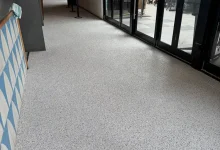
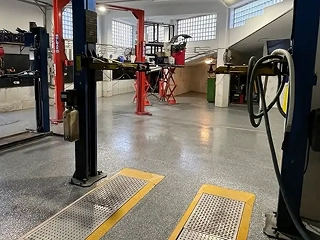
Automotive, mechanical, and fabrication workshops deal with oil, fuel, brake fluid, and metal filings. The biggest maintenance issue here isn’t usually chemicals — it’s grit. Metal shavings and grinding dust act like sandpaper under foot traffic and rolling tool carts. A daily sweep (or a magnetic sweep in metalworking areas) before mopping makes a noticeable difference to how long the topcoat holds its finish in a workshop epoxy flooring installation.
Warehouses
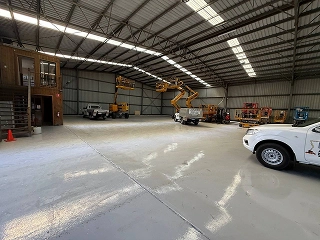
Constant forklift and pallet jack traffic is primarily a wear issue rather than a chemical one. For warehouse epoxy flooring, the most important habit is keeping forklift and pallet jack wheels in good condition — damaged wheels are the single biggest cause of premature scratching in high-traffic lanes. A weekly ride-on scrubber pass over main thoroughfares keeps grit from building up in the areas under the most load.
How Long Should an Epoxy Floor Last?
This is one of the most common questions we get, and the honest answer is: it depends almost entirely on maintenance and traffic, not just on the system installed.
As covered in our heavy-duty epoxy flooring guide, a properly installed industrial-grade epoxy system can perform for 10 to 15 years before major rework is needed. But that figure assumes a basic, consistent maintenance routine — daily sweeping, regular mopping, and avoiding the cleaning products and equipment issues covered above.
Floors that get genuinely zero maintenance — no sweeping, no mopping, spills left for days, damaged equipment dragged across the surface — can start showing topcoat wear in high-traffic areas within 3 to 5 years, well before the underlying epoxy system itself has failed. The base layers are often still sound; it’s the topcoat that’s worn through, and that’s a maintenance problem, not an installation problem.
When Does an Epoxy Floor Need Recoating?
Even with good maintenance, high-traffic commercial and industrial floors will eventually need a fresh topcoat — this is normal and expected, not a sign that anything went wrong.
Signs it’s time to consider epoxy floor recoating:
| ■ | The gloss has visibly dulled in high-traffic lanes, even after cleaning |
| ■ | Fine scratches are visible under direct light, even if the floor still feels smooth |
| ■ | The colour has become patchy or faded in sun-exposed areas (common near loading dock doors) |
| ■ | You can feel a slight texture change in heavily trafficked zones compared to less-used areas |
A topcoat recoat is significantly less invasive — and less expensive — than a full floor replacement, because the existing base coats and concrete bond usually remain sound. It typically involves light surface preparation (mechanical scuffing rather than full diamond grinding) followed by a fresh topcoat, with much shorter downtime than an original installation.
If you’re noticing any of these signs, it’s worth getting an on-site assessment before the wear progresses into the base coat — at that point, recoating is no longer enough and a more involved repair becomes necessary. For context on what affects pricing for both new installs and larger recoating projects, see our guide on industrial epoxy floor costs in Melbourne.
A Simple Maintenance Schedule You Can Actually Stick To
For most commercial and industrial epoxy floors in Melbourne, this schedule covers what’s needed without overcomplicating things:
| DAILY | Sweep or dust-mop high-traffic areas. Spot-clean any spills immediately. |
| WEEKLY | Damp mop or scrub the full floor with warm water and a pH-neutral cleaner. |
| MONTHLY | Check forklift, pallet jack, and trolley wheels for damage or embedded grit. |
| ANNUALLY | Walk the floor under good lighting and check for early signs of topcoat wear, especially in main thoroughfares and turning areas. |
| EVERY 5-10 YEARS | Budget for a topcoat recoat in high-traffic zones, depending on usage intensity. |
That’s genuinely the whole system. The floors we get called back to fix early almost always skipped the daily and weekly basics — not the annual or five-year items.
FAQs - on Epoxy Flooring in Melbourne
Can I use a normal mop and bucket on an epoxy floor?
Yes. A standard mop and bucket with warm water is fine for daily and weekly cleaning of most commercial epoxy floors. For larger areas — warehouses or workshops over a few hundred square metres — a wet-vac or ride-on scrubber with a neoprene squeegee attachment is faster and leaves less residue, but it’s not required for the floor to stay in good condition.
Will bleach damage an epoxy floor?
Repeated use of bleach or other harsh alkaline cleaners can gradually dull an epoxy topcoat and, over time, cause a hazy or chalky finish. Occasional use for sanitising (particularly in commercial kitchens) generally won’t cause immediate damage, but it shouldn’t be your default daily cleaner. A pH-neutral cleaner is the safer choice for routine cleaning.
How often does an epoxy floor need to be resealed or recoated?
Most commercial and industrial epoxy floors don’t need a full recoat for 5 to 10 years, depending on traffic levels and maintenance. High-traffic areas — forklift lanes, kitchen pass-throughs, workshop walkways — will show wear sooner than lower-traffic zones. A recoat is generally a much smaller job than the original installation, since the base coats and concrete bond usually remain intact.
Can epoxy flooring be damaged by forklifts or heavy machinery?
Properly specified industrial epoxy systems are designed to handle forklift and pallet jack traffic without issue. The most common cause of visible damage isn’t the weight itself — it’s worn or damaged wheels with exposed metal edges scratching and gouging the surface. Keeping equipment wheels in good condition is one of the simplest ways to protect a warehouse epoxy floor long-term.
Is epoxy flooring slippery when wet, and does it need special cleaning for slip resistance?
A plain high-gloss epoxy finish can be slippery when wet, which is why commercial kitchens and other wet-area floors are installed with an anti-slip aggregate topcoat. This textured surface still cleans easily with standard mopping, but avoid wax-based or oil-based cleaning products, as these can build up in the texture over time and reduce the floor’s slip resistance.
NEED HELP?
Free on-site assessment across Melbourne & Victoria · Fixed-price quote within 24 hours