
Warehouse Epoxy Flooring Melbourne
Get A Free Quote!
Response within 24 hours
- contact@melbourneepoxyflooring.com.au
- Melbourne, VIC, Australia
Melbourne warehouses run hard — constant forklift traffic, heavy pallet loads, chemical spills, and the pressure of keeping operations moving with minimal downtime. Bare concrete can’t keep up: it dusts, stains, cracks under repeated impact, and becomes a WHS liability. Epoxy flooring is the industrial standard for Melbourne warehouses and distribution centres because it creates a seamless, forklift-rated surface that protects the slab, improves safety, and lasts 10–20 years under daily heavy use.
The biggest obstacle was getting all that adhesive removed to get down to the concrete.
Why Melbourne Warehouses Choose Epoxy Over Bare Concrete
Bare concrete is porous, it dusts constantly, and it can’t handle repeated chemical exposure or sustained forklift traffic without cracking and staining. In a working warehouse, that’s not just a maintenance problem — it’s a WHS liability. Concrete dust alone can contaminate goods, damage equipment, and trigger workplace health concerns under Safe Work Australia guidelines.
Epoxy flooring solves this by creating a hard, seamless, non-porous barrier over the concrete slab. The result is a surface that handles forklift loads day in and day out, resists oils and solvents, reflects light to improve visibility, and is genuinely easy to clean without specialist products or procedures.
Why Choose Warehouse Epoxy Flooring?
- Forklift and pallet jack rated
- Resists oils, solvents and battery acid
- High-reflectivity — reduces lighting costs
- Safety line marking for forklift lanes and pedestrian zones
- WHS and Safe Work Australia compliant
- HACCP-friendly for food storage
- 10+ year lifespan
- Australian standards compliant
Choosing the Right Epoxy System for Your Warehouse
Not all epoxy systems are equal — and not all warehouse environments are the same. The right system depends on your traffic type, load weights, chemical exposure, and whether your facility has specific compliance requirements.
2-Pack Epoxy System
A solid two-coat epoxy system for light-to-medium warehouse traffic. Good chemical resistance and durability for lower-intensity environments such as storage facilities with infrequent vehicle use.
Best for: Storage rooms, retail back-of-house, light-use warehouses
100% Solids High-Build Epoxy
The industry standard for serious warehouse environments. Higher film build, greater impact resistance, and superior durability under constant forklift and pallet jack traffic. Often paired with a polyaspartic or polyurethane topcoat for UV stability and faster cure.
Best for: Distribution centres, logistics hubs, high-traffic aisleways
Epoxy Mortar System
A thick, aggregate-filled system for the most demanding industrial environments. Exceptional impact resistance for areas with heavy dropped loads, steel-wheeled equipment, or extreme thermal cycling. Also suitable for damaged or uneven concrete substrates.
Best for: Heavy manufacturing, metal fabrication, impact zones, cold storage
Get A Free Quote!
Response within 24 hours
- contact@melbourneepoxyfloor.com.au
- Melbourne, VIC, Australia
Warehouse & Industrial Facilities We Serve Across Melbourne
Distribution Centres
High-traffic aisleways, dock leveller zones, and pick-face areas — we specify systems that handle 24/7 pallet jack and forklift loads without surface breakdown.
Logistics Facilities
3PL warehouses, freight terminals, and last-mile distribution hubs across Melbourne's western and south-eastern freight corridors.
Manufacturing Plants
Production floor coatings that handle heavy machinery, chemical exposure, and the specific slip-resistance requirements of manufacturing environments.
Cold Storage Facilities
Thermal-shock rated systems designed for coolroom and cold storage environments where temperature cycling causes standard epoxy to fail.
Food Storage & Logistics
HACCP-compatible seamless flooring for food distribution and storage facilities where hygiene compliance is non-negotiable.
Pharmaceutical Storage
Dust-free, antistatic epoxy systems for pharmaceutical and medical device storage facilities with strict contamination control requirements.
Melbourne Industrial Zones We Cover
Choosing the Right Epoxy System for Your Warehouse
Not all epoxy systems are equal — and not all warehouse environments are the same. The right system depends on your traffic type, load weights, chemical exposure, and whether your facility has specific compliance requirements.
2-Pack Epoxy System
A solid two-coat epoxy system for light-to-medium warehouse traffic. Good chemical resistance and durability for lower-intensity environments such as storage facilities with infrequent vehicle use.
Best for: Storage rooms, retail back-of-house, light-use warehouses
100% Solids High-Build Epoxy
The industry standard for serious warehouse environments. Higher film build, greater impact resistance, and superior durability under constant forklift and pallet jack traffic. Often paired with a polyaspartic or polyurethane topcoat for UV stability and faster cure.
Best for: Distribution centres, logistics hubs, high-traffic aisleways
Epoxy Mortar System
A thick, aggregate-filled system for the most demanding industrial environments. Exceptional impact resistance for areas with heavy dropped loads, steel-wheeled equipment, or extreme thermal cycling. Also suitable for damaged or uneven concrete substrates.
Best for: Heavy manufacturing, metal fabrication, impact zones, cold storage
Warehouse Epoxy Flooring Across Melbourne's Industrial Corridors
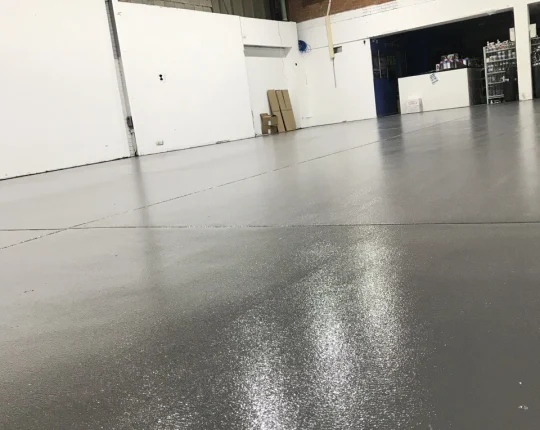
Over the years, we’ve installed warehouse and industrial epoxy flooring across Melbourne’s major industrial corridors — from large distribution centres and logistics facilities in Derrimut, Truganina, and Laverton North to manufacturing plants and storage facilities in Dandenong, Campbellfield, and Somerton.
Every job follows the same standard: full concrete degreasing and diamond grinding, the right epoxy system for your floor loads and environment, anti-slip topcoat, and safety line marking for forklift lanes and pedestrian zones where required. We don’t vary the process based on job size — a 500m² storage facility gets the same preparation standard as a 5,000m² distribution centre.
Our gallery shows completed warehouse, industrial, and distribution centre epoxy flooring projects across Melbourne’s suburbs — before-and-after, system types, and line marking layouts.
FAQs - on Epoxy Flooring in Melbourne
Which epoxy system is best for heavy forklift traffic?
A 100% Solids Epoxy base coat paired with a high-durability Polyaspartic or Polyurethane topcoat is the industry standard for heavy warehouse traffic. The 100% solids system provides a thicker, harder film build than water-based or standard 2-pack epoxy, giving it the impact and abrasion resistance needed for constant forklift turning and pallet jack loads. For extreme conditions — heavy manufacturing, drop zones — an Epoxy Mortar system provides an additional level of impact resistance.
Can epoxy handle forklift traffic near loading dock doors with UV exposure?
Standard epoxy resins yellow (amber) in direct UV light — this is a chemical property of the resin, not an installation defect. For areas near loading dock doors, skylights, or any sun-exposed zone, you must specify a UV-stable topcoat. We use Polyaspartic or Polyurethane topcoats in these areas, both of which are UV-stable and maintain their colour and clarity long-term. We always confirm UV exposure zones during the site assessment and specify accordingly.
How long will my warehouse be shut down during installation?
For most Melbourne warehouse installations, foot traffic is possible within 24 hours and forklift traffic resumes within 48–72 hours. Full pallet loading and heavy vehicle traffic should wait 5–7 days for a fully cured system. For larger facilities, we often section the floor so part of the warehouse remains operational while we work through it in stages. Weekend and after-hours installs are also available if shutting down during the working week isn’t practical.
Why is epoxy better than bare concrete in a warehouse?
Bare concrete is porous — it absorbs oil and chemical spills, generates concrete dust that damages stored goods and equipment, and degrades steadily under repeated forklift and heavy vehicle traffic. Epoxy creates a hard, non-porous barrier over the concrete that resists chemical penetration, eliminates dust, improves slip resistance, and handles forklift and pallet jack loads without cracking or staining. It also reflects significantly more light than bare concrete, improving visibility and potentially reducing artificial lighting costs.
How do I maintain a warehouse epoxy floor?
Daily sweeping or dust-mopping of high-traffic aisleways, a weekly wet scrub with a pH-neutral cleaner, and keeping forklift and pallet jack wheels in good condition is genuinely all that’s needed for most warehouse epoxy floors. The biggest maintenance risk isn’t cleaning chemicals — it’s worn equipment wheels with exposed metal edges, which scratch the topcoat over time. Our full epoxy floor maintenance guide covers warehouse-specific care in more detail.
Can you install epoxy in a cold storage or coolroom warehouse?
Yes — but standard epoxy systems aren’t suitable for cold storage environments, where temperature cycling causes standard coatings to crack or delaminate. We specify thermal-shock rated epoxy systems for coolroom and cold storage floors, which are formulated to handle repeated temperature transitions without adhesion failure. Moisture management in these environments also requires careful assessment, as condensation can create bonding challenges if not addressed at the substrate preparation stage.
Ready to Transform Your Warehouse Floor?
Get a free, no-obligation quote for your warehouse epoxy flooring project. Our team will assess your space and provide a detailed proposal within 24 hours.
Get A Free Quote!
Nospam, We Typically respond within 24 hours